26 July 2022

2022 Dorman Family Tour de Little France report


We’ve done some good riding over the past two weeks. Unfortunately, the extreme heat warning suggested that we shouldn’t try to finish the final stage of our ride - across the barrens to close the loop. It was this section of branch line — seen on an old map that my parents had on the wall after they moved to Harbour Grace  — that inspired us to start riding them.  But there’s always next year….


Many many thanks to everyone who supported us along the way, with encouragement and donations. Especially my mother who worried about us and her neighbour Timmy who kindly loaned us a bike! We couldn’t have done it without them. We rode 72.52 miles (116 km) on challenging terrain and thanks to your generosity, we more than exceeded our fundraising goals!

For those who are feeling inspired, there’s lots more branch lines out there to ride! 


24 July 2022

Stage 3 TDLF: The Queen Stage

This was an unexpectedly epic ride. It was cold and cloudy when we left the cabin - very unlike recent weather.  We rode the 6 miles to the main trailway, and turned west.  The track here is wide and in good shape, but with a strong headwind and heavy rain the day before had left lots of puddles.  We got to Whitbourne without difficulty and stocked up on provisions. 


We picked up the branch line next to the community garden. It looked a little unpromising, so I asked an older gentleman if it was the old track. He looked doubtful, then said yes, but you won’t get through like that.  It did look a little wet… and oddly low lying for a track bed. 
Unfortunately for us, it got worse. Not just wet but mud. Proper Newfoundland bog seemed to have swallowed the track bed. But we didn’t let that stop us!
We did get through to the Trans Canada, where the track passes into a culvert, and then becomes a gravel road through to Blaketown, but I really wouldn’t encourage anyone to try it. 

After passing the foot of Dildo pond, the track runs up the east side of the pond before turning inland towards Broad cove junction , where the line turns off towards Tilton and Harbour Grace. This segment was also pretty wet, but less boggy.  

At Broad cove Junction we turned west, towards Trinity Bay and cold beer (for me) in Dildo. The track here is dry and fairly stable. 


Really glad we did this route, but it was not easy. Some sections we were on foot more than on our bikes! 


20 July 2022

Stage 2 of the Tour of Little France

 On day 2 we picked up the CBN trailway at Cupids.  Our support team got the bikes ready. 


After a brief sweep east, it heads south towards the Trans-Canada. This is a long straight run, with fairly good surfaces.  We had a stiff headwind most of the way which made it a bit of a slog, but it’s fairly scenic and a pleasant, quiet ride, with little ATV action until you’re near the  TCH. 

There’s a road tunnel under the highway, but you do have to cross an access road on both sides.  The branch line continues south to Brigus Junction, where it meets the Newfoundland Trailway, ie the old track across the province.  We turned west onto the trailway (our headwind seemed to follow us), and headed towards our cabin, which is near Ocean Pond. 

The big difference between todays stage and yesterday’s is that during the ride we didn’t enter any towns or areas and very rarely saw anyone else meaning that there was nowhere we could stop to buy anything even though we didn’t need anything specifically it had been nice to be able to stop and buy cold drinks  from gas stations.

Just after we passed under the trans Canada we saw a cyclist who was also looking at his phone for directions we went up and spoke to him and learnt that he was called Fernand Lussier and that he was from Sherbrooke, Quebec and that seven years ago he had ridden across Canada from Sherbrooke to Quebec but the. His grandson said “but Grandpa you haven’t ridden across Canada yet” so seven years later he took up his grandson’s challenge and is just now finishing it.                                                                


After reaching the trans Canada I (Bram) became physically and mentally tired because we had both been thinking about it as the end while really there was still a large chunk to go and it just kept going but  then we reached a small pond and we went for a quick swim and it really helped refresh us.
 

We had another swim when we got to our cabin —this time joined by two beavers and two loons. Very Canadian. 


18 July 2022

Stage 1 of the Tour of Little France

Harbour Grace to Cupids: this was a trial ride, to see how our bikes worked, and to see how fit we are (not very). 

We got in the track at River Head in Harbour Grace and immediately regretted it. 

The old track from Harbour Grace to Tilton is the worst we’ve ridden, and seems to have gotten worse in recent years. 

Loose, heavy gravel or big rocks. There’s also a diversion in Tilton where a lumber yard’s  expanded over the track, and put in a very rough and unpleasant diversion. But after that it wasn’t too bad. In some places it is classic ‘old track’ and totally rideable while in others it has been widened and smoothed.  The start of the section from South River to Dildo is tough going, but soon settles down to a long straight run on an embankment towards the old CBN Highway. 

Lots of work has been done on the track recently, especially around Bay Robert’s and Clarke’s Beach but that area was also swarming with ATVs. Most of them were lovely and considerate and moving slowly, but a few places had lots of kids on three wheelers, riding fast and kicking up a lot of dust.  But no problems and everyone very friendly.


I didn’t stop to get pictures at any of the roughest sections, but there are some great bridges. The track sections which run through the ponds along the coast are just fab too. 

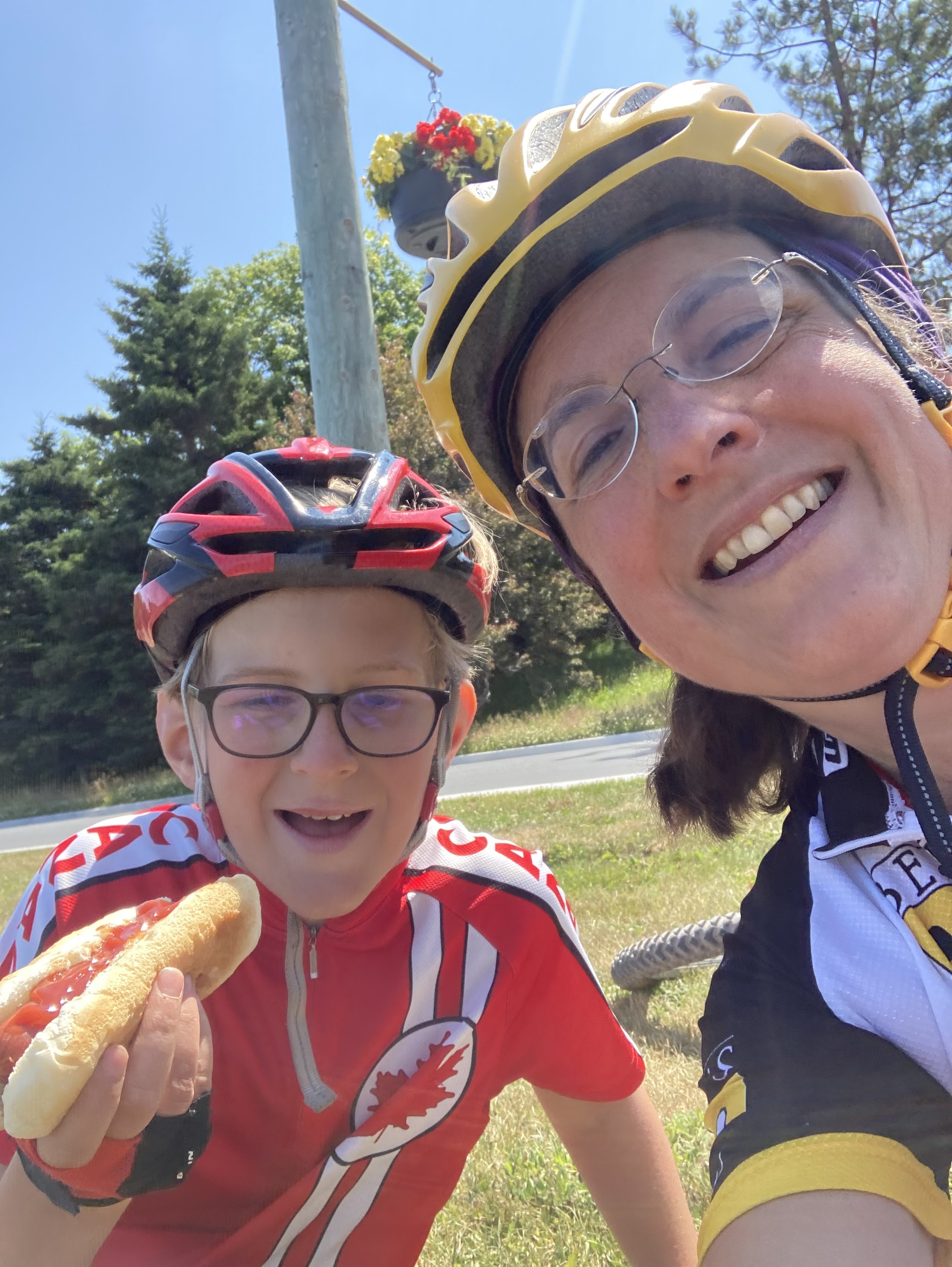
This part of the trailway winds through lots of communities. In the BayRoberts area, a lot of the track sections have become roads, but quiet ones.  ATVs are routed away from some roads, but on bikes we were able to stick to a straight line, mostly on the original route. Also lots of shops for buying cold drinks, and even lunch stops. We had hoped to have lunch at the baccalieu trail brewery but it wasn’t open yet, so instead we got hot  dogs at the gas station and ate them while watching the seabirds in Spaniards Bay.  

Overall we rode just under 40km, which was enough for our first long ride in several months. We stopped a lot, to reapply sunscreen and empty our bottles, we even paddled in a pond. We had a hare lollop across the path, and a red squirrel dashed across too. Amazingly, the bikes held up, and we’re looking forward to the next stage. 

Tour de Little France details: https://www.justgiving.com/fundraising/dormanfamily 


23 October 2021

Is Gravelfoyle all it's cracked up to be?

Captivated by this video (filmed in stunning July weather) I booked a family half term holiday to Aberfoyle in October.  We'd already had one holiday to the area cancelled by Covid, and have hiked a few hills and biked a bit on the other side of Loch Lomond, but Aberfoyle (aka 'Gravelfoyle') was totally new to us. 

Once I worked out that we could hire bikes (why do no hire car services provide bike racks?), I quickly booked the only accommodation that I could find, and waited for October. 

The weather did not live up to our expectations, but everything else did.  Nick and Ross at Aberfoyle Bike Hire sorted us out perfectly. They were super helpful (especially when this summer another rural bike shop wasn't even picking up the phone).  The cottage we hired was very nice and perfectly located - a max 5 minute walk from 2 pubs, a big co-op,  and a tonne of cafes, and plumb on the bike routes.  It is so nice to be able to get newspapers while on holiday, to know there's a chemists near by, not to have to worry if you've forgotten something (all challenges we've encountered on other ventures out of Edinburgh). Also excellent wifi and mobile connectivity.

Despite the rain, we had a blast cycling around the 'Gravelfoyle' routes.  The surfaces are all different, but excellent. The gravel roads are mostly vehicle free, and the few utility vehicles we saw were all very cautious and friendly.  And we only covered a fraction of the possible routes.  

We did  a short loop around Lochan Spling to test our bikes the night we arrived.  Then a long but fairly flat  loop around Loch Ard, and paths south of it, checking out Black Linn of Blair Vaich, and various historic ruins.  On our one (mostly) dry day, we did a big, hillier loop in the Achray Forest, on NCN 7, coming back via Duke's Pass, which dropped us straight back at our front door.  Both of these were more properly half-day rides, but we stopped a lot to take pictures, explore, and eat.  My one complaint was that the 'waymarked routes' on the Gravelfoyle website didn't entirely map onto the waymarking on the ground.  At any rate, they have different names to what is used on the maps available in the super friendly tourism office, just next to the big (free!) car park.  We found it helpful to have OS maps and a GPS to show us where we were. There are also tonnes of routes online, using Komoot.  

The start of the paths where NCN 7 leaves the A821 are also worth exploring on foot - lots of stuff for kids to play on,  waterfalls, art, and a hide where you can watch red squirrels and birds. 

So, yes. Do go to Aberfoyle.  It's beautiful and friendly and well worth a visit.


03 January 2019

London by bike with kids

With a bit of specialist kit and some twitter friends it is possible to 'do' London as a family by bike.  

We took our 2 kids - one primary and one secondary aged -- and our trusty 8 year old Circe Helios tandem down by train. In London, we borrowed another - rather newer - Helios from a local cycling family.  

With two panniers that transform into backpacks, we tackled 60-odd miles of London over 5 days.  We saw Tower Bridge and toured the Tower.  We rode the east-west cycle super highway (CS3) by day and by night.  We went to a play in Southwark (Q1) and tackled the Farringdon infrastructure (CS6)  in both directions.  We pootled around Hyde Park and Green Park, saw Buckingham Palace, and the Horse Guards at Whitehall and visited museums. 

While the segregated infra was definitely the best,  the permeable connections from Bloomsbury to Angel (Q2) and around de Beauvoir in Hackney  (CS1) were pretty good, if not deserving of being called a 'super highway'.  The family was also convinced that CS1 took us round in circles until they looked at the Garmin track. The one section that got an overwhelming thumbs down was Exhibition Road, which had a lot of through traffic and where a kid jumping out of a 4x4 nearly doored us.  

On the streets, drivers were surprisingly forgiving, although the busses seemed to see us as competition. It being the holidays, there weren't many commuters, but instead a lot of folk cycling to the shops, or, in the city centre, tourists and locals on rental bikes. 

All in all, a good trip. We're looking forward to getting home, but  we'll miss the infra and the 'normality' of cycling in London.  Hopefully Edinburgh will learn from London's mistakes and build only the best. 


11 April 2018

Why are we still building infra that's not suitable for 8-80 year-olds?

Another in a series of blogposts 'inspired' by trying to get my kids to half-term/holiday activities in Edinburgh.....ie child-friendly locations that attract families from all over the city.

This Easter, I've been cycling with my kids to a nearby local school for bike camp.  There are two possible routes. Both are more than half on off-road cycle paths. The first one, which replicates my commute is flat but to get there we have to go through the worst intersection in Edinburgh.

The kids have voted with their legs and prefer to climb a hill to avoid that junction.  The nice off-road cycle path that runs through Bruntsfield links and along South Meadow Walk takes us across one well designed intersection with a toucan.  But then we come to the junction of SMW with Middle Meadow Walk (MMW), Melville Drive and Argyle Place.

This is one of the most used bits of cycle infrastructure in Edinburgh, and as a result was redesigned a few years ago.  At the time I said that it was not well-designed for pedestrians (unsurprisingly, they ignore the dropped curbs and follow a desire line that takes them straight across the cycle lane).   It's better now in some ways for cyclists who want to turn onto or off of MMW.  But if, like my kids, you need to continue on SMW, it's a nightmare.  It's a classic piece of infra that sort of works for grownups, as long as you can swivel your head simultaneously in five directions and start at a sprint.  But it's nearly impossible for kids to judge the on-coming traffic - cars, buses, lorries, and bikes, coming at them from multiple directions.


In the above - we are the red line trying to continue on the cycle path, cyclists are yellow and cars are green. What you can't see is that it's not a straight line.  First we cross the one way slip road for cars joining Melville Drive, then we hang about in the middle of the cycle infra, trying to spot cars turning in various directions, while also dodging cyclists and trying not to block pedestrians who are oblivious that they're not supposed to take the most direct route to their crossing point.

There is no way the kids could do this on their own, and no signalled crossing anywhere nearby that they could dismount and use either.

Which begs the question 'WHY?"  I suspect the answer is that the council's focus is on commuting routes.  Ignoring the 5 schools in close vicinity, the playpark, the football pitches, etc.

I don't have the energy to go look at how much this cost.  It's certainly better than what was there before, but we pointed out all these shortcomings when it was in the design phase.  Which raises the bigger question: why are we still designing and building infrastructure that doesn't meet the needs of all its users?  why are we building 'slightly better but still crap' infrastructure? and what will it take to move past this bodged half-way house?

08 October 2017

Review: Lumos Helmet

Despite much derision on my beloved cycling forum, I backed the Lumos helmet kickstarter a couple of years ago.  It took a while to arrive, but eventually turned up last December.

Having now ridden it through one winter season, and even through the summer (when I would usually go helmet-less), I  thought I should write a review.  Especially since every single day of those 10 months at least once person has commented on it or asked me about it.  I've had people chase me down the road to discuss it, and one woman even rolled down her car window to ask about it.

Generally, people just want to know where I got it.  If they ask me if I like it, I say yes, which is true.  It's proven reliable. I've gotten in the habit of signalling my turns, and I do like being able to keep my hands on my bars/brakes.  I still tend to hand signal, but I like having the flexibility.

The main downside is just that it's heavy.  I don't notice it much on my short commute, but I don't wear it on longer rides.   Occasionally the lights glitch and don't respond to the switch but a re-charge sorts it.

Battery life is good if just using the indicators but short if using the brake light accellerometer, but I plug it in at work, and it's no more bother than normal rechargable lights. I do wonder if i'm havung to charge it more frequently these days though....

When it first arrived, I thought the switch on the back looked like a weak spot (especially for those of us with finger nails), but it's held up fine.

I've not used the app much.  It's handy for varying the rate of beeping (which accompanies the turn signal), but once I got that set, I've not used it much.  Oddly, the app only works  if the helmet's turned on.  So, I can't sit at my desk and check if it needs charging.

I don't know if I'd pay full price in the shops for it (£159 on amazon) but for what I paid, I'm happy.

13 September 2017

Journal ownership models

When people talk about journals as 'black boxes' usually they mean things like how reviewers are chosen, and the decisions made by editors. We don't talk much about journals as capitalist ventures, beyond decrying the cost of subscriptions (see my posts on Open Access) or predatory journals.  But there are many models of journal ownership and management, and if we understand them, we can make better sense of apparently puzzling decisions.  Here are five with which I am acquainted.  I'd be interested to know of others, or for corrections to my models.

Model A: the Learned Society journal:  this is a journal that is published by a learned society or disciplinary group.  Ownership is vested in the professional association, who contract with a publisher to publish the journal, and with a group of academics (often based in one department) to edit it for a number of years.  Some journals stay in certain foundational departments, more often they move around, and departments are invited to bid for them periodically.   Learned socities often use journal funds to pay for their administrative costs, run conferences, and other activities of benefit to their members.  Possible examples*: BJPS, ASR

Model B: The Association Journal: whereby a collective body or organization owns the journal, but editors are selected, rather than solicited.  A contract with a publisher ensures that the journal is published.  Funds again usually go to both administrative costs, editorial costs, and to support other endeavours of the owning group. Possible examples*:  African Affairs, Africa 

Model C: the Collective Model.  Ownership is vested in the editorial collective, and decisions about editors and often about papers are made collectively.  Both journals that I know which run on this model date from the 1970s. Again, a contract is negotiated with a publisher, and money is often used to run conferences, sponsor academic travel etc, as well as cover the costs of editing the journal.  Examples: JSAS, ROAPE

Model D:  the Private Ownership model. The journal is owned by an individual and profits accrue to them.  That individual might contract out the editorial work, or take it on themselves.  Possible examples*: TWQ

Model E: the Publisher-Owner model.  The publisher 'owns' the journal and contracts with an editor or editors to run the journal. Possible examples*: JMAS

In the case of models D and E, I presume that proceeds of the journal pay salaries and other expenses, but are less likely to support conferences and other activities, but I may be wrong.  Certainly editors could negotiate such agreements into their contracts, if publishers were amenable, but I'm not aware of examples that do this.  It's also difficult to know whether journals are Model D or E, since we're not usually privy to their contractual arrangements.

How any of these groups relate to their editorial boards is generally unrelated to their ownership, with the exception of Model C, where the editorial board is resposinble for both organizational and editorial decision making.  In Models D and E editorial boards usually serve at the pleasure of the editor.

Finally, peer review is unrelated to both ownership and management.

*This is based on the best of my knowledge. Please let me know if I'm wrong, so I can correct it.

17 December 2016

The gendering of transport starts early

On-line campaigns #letkidsbekids and #lettoysbetoys have done a great job of de-gendering toys, colouring books and clothes, but I've been struck at how insidious the gendered message still can be.


My kids mostly wear clothes from our Nearly New Sale, and hand-me-downs, so I can't be too fussy about what they wear, but as my little boy grows, I realise how hard it is to avoid motorbikes and car motifs on his clothes.

When they're toddlers, it's okay for them to have busses and trains, and maybe animals riding bicycles.  But as they hit primary school, everything that's not superheros or disney sends signs that big boys should be petrol heads.  Sure, there may be an occassional 'rad' bmx-er or skateboarder on a t-shirt, but they're swamped by the cars, even on the 'quality' kids clothes.

My daughter, on the other hand, gets given dresses with bicycles on them - bikes for riding to picnics, with flowers on them....

04 August 2016

The problem with cyclists...

One of the main 'take-aways' from the recent #roseburn meeting (more on that soon) was  that Edinburgh's already a great place to cycle, so why do they need to do it down 'our' street (one of the main arterials into the city centre...).

Speaker after speaker claimed to 'be a cyclist myself' and rhapsodised about Edinburgh's amazing oof-road cycle routes.  To paraphrase one audience member 'there are lots of places that people can already cycle, amazing cycle paths'.  And, that's perfectly true, but they don't take you into the city centre to work!  Others suggested that the NCN route (the one that runs down the tram tracks) is under-utilized, and needs better signage...

The real answer, as Peter Gregson* himself, admitted "The problem with cyclists is we don't want to take funny awkward routes".  

And, of course, he's right.  There are lots of reasons that cyclists don't use existing 'funny awkward' routes - like ones that take you through a park full of kids and pedestrians, up and down hills, and through dodgy intersections - but they will use safe, well-designed routes, and even more importantly, so will people who don't currently cycle, as we're seeing in London:

Cycling now major transport mode in LDN: 645,000 journeys a day, 10% up from 2013. Morning rush trebled since 2000 pic.twitter.com/3gZPIwp0EE
This shows, if nothing else does, why 'quiet routes' won't increase cycle use enough to make a difference, but good infrastructure will.

If we take seriously concerns about pollution, congestion, the massive expansion Edinburgh is under-going, and the inability of our road network to cope with increased single-occupancy vehicle usage, then we need to build direct, easy to use arterial networks.

Reducing car usage is what will enable emergency vehicles to get through our streets, deliveries to shops, and essential traffic.  It's the excess car use that blocks up Roseburn and keeps the buses from running.

Transforming the environment into one that doesn't privilege rampant car use - but allows those who need cars to do so - is the main plank to keeping Roseburn moving, and that means cyclists too.


* The individual behind the 'anti' campaign. 

02 August 2016

Cycling Paradise...in Scotland?

I spent last week looking out my kitchen window at family groups cycling down the middle of the road, mums with their handbags dangling from their arms; sober, sedate older citizens cycling home with their newspapers and loaves of bread; groups of early teenagers zooming around *without helmets* on their own. In fact, the first 48 hours I was there I didn't see any helmets at all, despite seeing dozens of cyclists - far more than I saw moving cars.

Amazingly, I wasn't in Holland, or Paris, or Copenhagen.  I was in Scotland, about 50 miles from Edinburgh, in Elie.

Elie's a little seaside village, popular with tourists, and even more popular as a holiday home or vacation spot for the well-heeled.  But the narrow-crowded streets make driving a nightmare, so families bring their bikes, or rent bikes for the duration of their holiday, and cycle back and forth to the beach, golf courses, and tennis courts.  I particularly liked the moment I peered around a narrow corner and was confronted by 3 lads in wetsuits and flipflops, cycling along casually with their phones out, while a car waited patiently behind them.  Or looking out the window as it got dark, to see the cheeky grin of the 8 year old staying below us, who had cycled home at 10pm, and had clearly left his parents some way back with his little sister. 

Elie is a privileged space, and perhaps not easily replicated outside Centre Parks, but it was nonetheless immensely refreshing to see that *in the right space* parents were willing to hop on their bikes, let their kids have some freedom, and leave their cars at home.  


23 May 2016

5 things you need to know before cycling with your kids


Please forgive the clickbaity-title.  I've been thinking about this post for a while, and got inspired by a discussion on the Family Cycling facebook group.  On the one hand, I think we're probably just lucky - our kids rarely whine that they're tired (refueling usually helps) and really seem to enjoy going places by bike.  But, a bit a parental strategy helps.  If you're going to cycle regularly or any distances, you'll end up on the roads at least some of the time. These are my tips for happy family cycling: 

1.  Accept that it will be stressful  Yes, riding bikes is fun and good for you and a speedy way to get around, but riding on roads with your kids is incredibly stressful. It helps if you have two adults. It also helps to keep on quiet roads as much as possible.  Around Edinburgh we can easily ride 10 miles in all directions with 90% on off-road paths, but even then the remaining 10% is exhausting.  On the plus side,  your kids will grow amazingly in confidence and skills.

2. Don't try this until you can trust your kids to listen to you and do what you say. This is a pretty big caveat. You do have to have kids who stay (mostly) tuned in, and alert to your instructions.  It helps if they know their left and their right too (this also goes for parents...).  You also need to be sure that everyone understands the rules.  We had a disaster once when riding with friends whose son wasn't all that confident.  I started through an intersection that I've taken my kids through dozens of times.  I made eye contact (think Paddington stare) with a car that was indictating to turn across us.  I told the kids - behind me - to go as well.  I was shielding them from the car, but moving.  Then my friend, bringing up the rear told the kids to 'watch out for the car'. So the non-confident child braked and froze in the intersection, my daughter ran into him and came off in the junction, and I cycled off, not knowing what had happened.  There are two lessons here: (1) I shouldn't have tried to go through the intersection. We should have got off and walked. Or, I should have stopped my bike and blocked the turning car. (2) Make sure that kids know that only STOP means stop, and that you have to keep going when there are other cyclists behind you.

3. Always keep the kids in front of you This is the one big rule that I frequently want to shout at parents I see on the roads.  You need to be able to see your kids.  Yes, this can mean that they're riding in front of car doors and other obstacles.  You don't want them too far in front.  But you need to be behind them and, if possible,  a little to the right (for those of us who drive on the left).  The ideal situation is two experienced/adult riders, with the most confident bringing up the back, but that's not always possible.  So, remember, kids in front, but it's your job to tell them to 'start slowing down' / change gears/ get ready to go because the light's changing etc.

4. Have a get-out clause, but don't let them know! if they're small start by taking your normal bike-seat, tandem or trailer along as well.  That way if it's too much, you can still bungee their bike on and take them back home.  Trailgators accomplish this too. But the real trick is not to let them know that the tow home is an option.  So, make the trailer look really full of picnic blankets or siblings or whatever and don't offer 'do you want to get in and ride home' unless you have to.  If you don't mention it, they may not twig.  We've done this with both our kids and never had to use the emergency escape route.  With our first, we just assumed she'd get in the trailer on the way back after pedalling 2.5 miles to Duddingston Loch on a 10" wheel bike.  But nope, she rode all the way home too.  With our second, we were a bit savvier.  We didn't bother with the trailer, but we did take the tandem and bungees.  After a couple of months we left the tandem at home and all rode 'normal' bikes.  Another clever wheeze is to always plan rides that intersect with train lines, at least for the first few months - we've only bailed once, when we'd badly underestimated the weather and had a very cold toddler, and then my daughter wiped out (she was looking at the Forth Bridge and went off the path...).  Luckily we were near Dalmeny Station, so we abandoned our planned ride, jumped on a train (thanks to an understanding guard) and went happily home.  

5.  Peer pressure is the best: Organize a ride with some friends and your kids will be amazed to find they've cycled 10 or 15 miles easily in a day.  Seriously though, not only will they think if he can do it, so can I, but they'll also ride twice as fast with a friend their age as with you.


Finally, to combine all these things -- go somewhere fun, but have a back up plan, and some rewards.  My daughter managed over 25miles on a 20" bike when she was 7 - it was also the 3yo's first long ride as stoker on the tandem.  We had an incentive that we were meeting friends for a cool event out at East Fortune (the National Museum of Flight), and that we could easily get the train home. It was a fabulous ride, much longer than we'd have done if we hadn't known there were train stations all the way along.  We also took the child seat and knew that we could always put the 7yo on the tandem and the toddler in the bike seat if we needed to.  We had a great ride, a fun train ride home, and then dinner at our favourite restaurant as a treat.


09 May 2016

Operation Souped-up Islabike a success!

Following on from my previous post, all about chainsets and gear-ratios and other things I don't really understand, I'm delighted to report that our attempt to retro-fit a larger chainset to the Islabike has been an unqualified success. 

We were lucky enough to find a 36T chainwheel, with cranks exactly the same length as his current ones, in the magic drawers of the Bike Station. In fact, so lucky, that we didn't realise we'd found them.  Our co-conspirator (who unlike me actually understands things like cranks and chain sets) bought it for another refitting job he's doing, thinking it was a 32, but realized later that it was just the right size.   

On Sunday, we he disassembled the Islabike, attached the new chainset and off we went. A definite improvement - noticeable, but not so much that it affected his ability get started or to climb. And hugely better on the flats.  He still rides it a bit like a bmx, but there's a lot less spinning and coasting.  

Which makes me wonder if Islabikes and Frog might want to consider marketing some 'longer distance' bikes, or at least an option of buying your bike with a 32, 36, or 40 chainset?   Or even just having these parts available to order? 

If our lad found the bike undergeared within 6 months of fitting on it, and riding distances of between 10 and 20 miles, then surely there must be other folk out there in the market for such adaptations?  

08 May 2016

How to choose a kids bike...or why it's not just about wheel size


When we go cycling en famille, we are quite often all on 20" wheels - an Islabike Beinn small, currently ridden by my 5yo; my Dahon Helios folder; and our Circe Helios tandem.  But there is a huge disparity to our pedalling rate. The little guy's legs go around and around, even when the rest of us are coasting.  We noticed this when our daughter rode the same bike, especially when we started doing longer rides.  But with the 5yo desperate to keep up with his big sister, he's more often out of the saddle, than in it. 
(Although unusually for us, in this picture the two leading cyclists are on 24" and 700cc wheels)


Which is okay for short rides, but pretty tiring when he's doing a decent 15 miles around Edinburgh's old railway paths, which tend to be pretty flat.


What we discovered when we discussed this apparent paradox, is that contrary to general opinion, wheelsize and the number of gears on your bike really don't make much difference. It's crank lengths, and, perhaps more importantly, gear ratios, that we should be worried about.  

Kids bikes are geared low to make it easy for them to start pedalling, go up hills, etc.  So my guy can sprint up hill, but struggles to keep a steady pace on the flats, because he 'spins out'.  I wondered if any other comparable kids bikes had higher gearing, but that data required some digging, and I thought I'd share my findings*:


This suggests that Frogs have higher gearing on their first bikes than Islabikes do (my kids just rode generic second-hands at this stage, so I can't compare).  But, when you get to geared bikes for 5-6yos, there's not much difference. 

I'm intrigued though by the Frog 58, which with a 34T chainwheel looks like a much better 'next bike' for my 5yo than the Beinn 20 large, or the Luath 24.  His sister rode the Beinn 20 small until she was 8, but I have the feeling he might be moving up sooner than that.  

However, we've also got an expert bike consultant involved who's looking into retrofitting a bigger chainset to the Beinn, if we can just find one with small enough cranks.

*important caveat - I just pulled this data off the websites; please let me know if you spot anything wrong!  I've not included all their makes - I'm particularly interested in the 5-6yo demographic. Obviously, none of this should be taken as any sort of endorsement of either islabikes or frogs.I've not dug out data on kids bikes other than Islabikes and Frogs because their bikes are the smallest weights and their brakes are designed for small hands, and my kids both have tiny hands. 


25 April 2016

Normalising cycling...Cycling Normally...

What's your favourite part of Pedal on Parliament?

For a lot of folk it's the quirky bikes - the velomobiles, tall bikes and unicycles; for others it's the adapted bikes - tandems for partially sighted stokers, hand-powered cycles, recumbents, and side-by-side trikes;  most people comment on the kids - on their own wee bikes sometimes still with stabilizers attached; in box-bikes; tag-alongs,  and tandems;  while for others it's the cyclists in 'normal' clothes -particularly beautifully represented by Alison Johnstone this year, but also (perhaps less beautifully) by many others of us wearing jeans and t-shirts, or other combinations of 'normal' clothes.

But the people who I love to see - and who I always try to thank for coming - is the one group that gets flak:   the club cyclists in full matching lycra.

Every year after POP we get comments saying too much lycra, too many helmets, too much hi-viz.   And I'd love it if people didn't feel the need to wear all that kit for a short ride (although some of those 'roadies' have been cycling for 4-5 hours by the time they reach the meadows).  But the reality is that most folk don't feel welcome on the roads, and they don't trust drivers to not see them.

Hi-viz and helmets are indicators of where we've gone wrong as a cycling nation.  The clubbyness of our 'cycling culture' is a defensive reaction to out-group stereotypes, rather like teenage goths or punks 30 years ago.  Telling these folk to 'dress normally' without changing the environment that makes them feel like outcasts, is as much use as a well-meaning mother asking their kids  'dress normally please' when going to visit grandparents.

But the real reason I love seeing the roadies is because there is a tendency to suggest that cycle infrastructure is something needed by 'less confident cyclists like women and children' (as a draft document produced by Edinburgh Council put it recently).  And this shapes assumptions about the type of infra and how it is understood.

Infrastructure for 'women and children' is a fringe benefit, a nice thing to have, but not 'essential' like infrastructure for road-hauliers and important business-people getting to their offices.  And so, infrastructure is designed for leisure use, or to take kids to schools and parks.   But 'real' spending is reserved for dualling roads and building bridges.

We know that there is a compelling economic case to be made for investment in proper cycle infrastructure - great rates of return, with benefits for local businesses and the economy as a whole.

But in order to get that sort of infrastructure built we need to send the message that everyone - not just me and my kids - will benefit from investment.  And that is why I love seeing the roadies there - because they send a signal that even those die-hard road-warriors want and need better road design.

We need to design cycling into all of our roads - urban and rural, quiet and busy - so that cycling really does become something that everyone can do, in all sorts of clothes.

20 February 2016

The good, the bad, and the ugly of Edinburgh's dual network

A big chunk of Edinburgh's Active Travel Action Plan covers the creation of a 'family network'  now renamed 'quiet routes':

The map is here thanks to Chris Hill for the direct link.
There's been a lot of criticism of this approach, which is predicated on the assumption that fast, aggressive cyclists will stay on the roads and less confident cyclists will take 'quiet ways'.  This is of course a false assumption - 'confident' cyclists are just at much as risk from a bus that fails to indicate before changing lanes,  a driver who overtakes too closely, or a left hook SMIDSY.  Good infrastructure will be used by all, as we're seeing in London.

But I've defended Edinburgh's dual network approach because it was based around linking up our existing, yet fragmented off-road network - mostly based on old railway paths, parks, and the canal. While it would have been nice to start off by redesigning the big arterial roads that feed commuters into the city, the pragmatist in me valued the decision to prioritize linking up the existing well-used off road segments.

The first major bit of this work has been the Meadows-Innocent path - which is roundabout, indirect, and somewhat too narrow, especially if you ride a tandem.  But my kids love using it, and if I tell them we're going that way, I get a big cheer.   So last week, when cycling the two miles to the Commie Pool with both kids several times, it made sense to go that way.  The first quarter of the journey is pretty nerve-wracking, but once we get to the meadows we're on segregated paths and very quiet back streets (the sort we almost never meet a car on).   Except that the pool is a few hundred metres past the entrance to the railway path.  And that means that we need to make a right hand turn uphill across 4 lanes of fast-moving traffic - to get to one of the city's biggest sports venues.  It's also right next to the main halls of residence for the University of Edinburgh.  Getting back is just as bad.  Traffic flows steadily out of Holyrood Park, and turning across it at rush hour is fraught with stress.  There is a two stage pelican crossing, but it is almost exactly in between our exit and entrance from this short stretch of road - marked by the two red x's on the picture to the right.

Of course, we could get off and walk, although manoeuvring kids and bikes along pavements and through a narrow central island with railings and pedestrians is not one of my favourite things to do.  But it's frustrating to get so close and then encounter the deeply unpleasant, car dominated void that is Holyrood Park Rd.

Maybe the network will be extended.  But to my mind, this example shows up the very real limitations of the 'fill in the gaps' method of cycle planning.  Once the Canal-to-Meadows section is built, we'll have a protected route pretty much from our front door to 200 metres from the pool, but the last few yards will continue to be unpleasant and dangerous.   I've blogged before about how 'car-friendly' the pool is, but this really rubs it in.

The crazy thing is, despite the new infra being roundabout, narrow and indirect, it is a huge improvement on the route we used to use daily taking a toddler to nursery in a bike-seat.    But it makes the continued gaps all the more obvious.

22 September 2015

Living car-free in Scotland?

We've lived in the UK for over 20 years, and in Scotland for 12, without needing a car.  It helps that Oxford and Edinburgh have both proved cycle and walking friendly, and both have excellent bus systems too.  Even since we've had kids, we've not regretted not having a car in the city.  Just this summer, with an 8yo and a 4yo we managed expeditions by train and bike to Tantallon and Dirleton Castles, and their associated beaches.  It's great for the kids to have the experience of getting places under their own steam, and really seeing the countryside.  Plus it tires them out, so they sleep soundly at night :)

But half-term poses new challenges.  It's not that we can't cycle 40km easily in a day as a family, with the 8yo on her own bike, and the 4yo on the tandem.  And we're pretty adept at carrying supplies in panniers.  But a lot of places that we'd like to go require a train trip first -- like the off-road route from Glasgow to Loch Lomond.  The problem is that Scotrail only lets you book 2 bikes per train. And it won't take tandems at all (even 'compact' ones like ours).   So, while an ideal scenario would be to borrow a second tandem, load them up and take the train to Pitlochry, or up the West Highland way, we can't do that.  Even if we just took one tandem, we'd still have 3 bikes, which is also not allowed.  And as Alison Johnstone wrote earlier, just getting 2 bikes on some trains can be a challenge.

Supposedly, guards can use their discretion and let extra bikes on, but when travelling with kids, that's really not an option - you need to know that you'll all be able to get on trains, and arrive at a decent hour, not gamble on a friendly guard.   A few years ago, we got stuck on the platform at Longniddry with a toddler at dusk because the guard wouldn't let us on an otherwise empty train, because 2 bikes had boarded at an earlier station.  It didn't matter that the train was full of empty carriages, this particular woman was determined to show us that we didn't count and physically prevented us from boarding.  We had to wait another hour, as it got dark and cold. It spoiled a lovely day out watching the geese at Aberlady bay.   So, no, I won't be trusting to the good will of the guards when venturing further afield.

What's frustrating about this is that Abellio, the new franchise holder promotes itself as 'cycle friendly' and the Scottish government wants to promote 'cycle tourism'.  But I guess that's just for young fit couples, and single adventurous cyclists.  Not for families that would rather do without the hassles of car ownership.

Well, we've given in.  There is now a British license-holder in our family, and we'll be joining the car club as soon as we can.  But if the franchise terms for other lines and orders for new trains could contemplate some flexible seating into which bikes could go, or having multiple cars with bike carriage, then there would be so many more options for families like ours.

for more info:  http://www.spokes.org.uk/2015/07/new-glasgow-edinburgh-trains/

Off-balance

I ended in a bit of a twitter-slanging-match this morning.  With Stella Creasy of all people.  I've rather admired her style and approach to politics - she seemed to really want to bring an energetic, campaigning politics back into the Labour Party.  But I was disappointed by this tweet, which excerpted parts of a newsletter from her, which seemed very negative - portraying the Walthamstow 'miniholland' project as being about cyclists versus 'everyone else'.

GazLemon
Disappointed by @stellacreasy’s latest newsletter which echoes #miniholland concerns of a noisy pro-car minority http://t.co/WMiPfijqWM
22/09/2015 08:32

In our subsequent exchange, she kept emphasising how she was trying to 'balance' the competing needs.*  Which reminded me of how affirmative action campaigns for women are too often critiqued for not being 'balanced', and how often 'balance' is promoted by the status quo as a reason for keeping the status quo, as in this fun tweet that came in about the same time: 

accidentobizaro
"We have got to be very careful not to do things at a speed which will make male candidates feel that the cards are stacked against them."
22/09/2015 09:16   [
which links to this article. ]

Stella Creasy said that my comparison was 'silly'.  But is it?  surely our current infrastructure is built with cars and drivers as their primary concern?  

So here's my top examples of our transport infrastructure privileging cars, rather than active travel:

  • Tarmac is continuous across junctions, but pavements stop
  • Driveways and entrances to car parks always have dropped kerbs, but not pedestrian crossings
  • 'Green wave' traffic lights that turn green for cars, but give cyclists red after red
  • Wide corner radiuses that make it easy for cars to turn, but widen the crossings making it difficult for pedestrians to cross
  • Push buttons on toucans - do you ever see drivers having to get out and push a button? 
  • Dummy 'push buttons' on pelican crossings that are actually controlled automatically from junctions
  • Half of most roadways taken up with parked cars 
  • Road signs and parking meters on pavements, not on roadways, even though they deal with car regulations 
It's time to redress the balance - which is why we should all get behind the mini-holland schemes, and similar schemes elsewhere in the country. If criticism is needed, let's make it constrictive criticism, and not hide behind excuses of 'balance'. 

*  To be clear - she didn't use the word 'balance' - that is my reading of her various tweets and newsletter.  But she did say my comparison was "silly".