13 June 2013

The bins (part 2): is this what a victory feels like?

It's been a depressing day in a depressing week.  This was symbolised today  by people congratulating me on my 'victory' and getting a 'result'. That result can be seen here: 

Missed it?  It's that little white line around the bins, that seems to be magically keeping them in place.  It's the result of several weeks persistent lobbying.  Earlier in the week, it has looked like this: 


And before that like this: 


As chronicled in more detail in a previous post, this was an on-going quest, actually started by someone else, to remove the recycling bins from the sight-lines of a pedestrian crossing in front of a primary school.  

But have we really fallen so low in the stakes of civic activism that a little white paint around some bins (with promise of a more permanent corral when the pavement is redone), is counted a victory? 

It doesn't feel much like one.

07 June 2013

Why is there no 'autotrans'?

There's something I don't understand about transport funding in the UK.  Why is it that active travel funds  have to be 'bid for' from funds held elsewhere?  Why don't they just get budgeted for like other infrastructure?  I mean, we don't hear about plans to dual a motorway being contingent on the outcome of a bid to 'autotrans'?  or the improvement of local roads being cancelled because of an unsuccessful bids, do we?  (or have I missed the fine print?)

This has been puzzling me for a while, but became particularly pertinent today, with the very welcome news that the City of Edinburgh listened to our concerns about their previous proposals for Leith Walk, and have now put forward a revised set of proposals.  The new 'enhanced' designs respond to many concerns from local residents, workers and shoppers.  But they depend on a successful bid for national money, which we're now being asked to lobby the Scottish Government for.

Somehow, the Council happened to have exactly the right amount stashed away to improve Leith Walk, as long as it only involved existing tarmac and pavement configurations.  But add in 'bike lanes' and it's a whole new ball game and entirely impossible to do without 'securing outside funding'.

I do appreciate that the councils funds are limited, and I would very much like the Scottish government to fully back initiatives like this, because they will save them money many times over in health, environment and business income.

But, I still don't understand why projects like this are treated like they're optional extras, or somehow less important than 'normal' road building.  

Can anyone explain?


04 June 2013

Is this the worst intersection in Edinburgh?


View Larger Map

I've blogged about this intersection before, but hearing today that it's not going to be resurfaced for at least another year has driven me to it again.

King's Junction courtesy of Andy Arthur
First off, I should note that it needs more than just a resurface.  It also needs a redesign.  But, the design would not be as bad if you could take a clear and confident line on it.  Unfortunately, as you can just see in streetview above the road to the left and ahead of that blue van resembles the lunar surface. I burst two tyres here in a month earlier this year. The picture on the right shows the surface as you carry on through the intersection.

It doesn't help that cars waiting in the turn lane opposite regularly gamble on slow starts and nip across, even though vehicles coming from Tarvit street onto Gilmore Place have priority.  But anyone who rides or drives it frequently knows that their light is short and that only the first 2 or 3 cars will make it across, so they feel pressured to bully their way through.  And, if you are lucky enough to approach the light while it is green and make it through, inevitably a pededstrian walks out in front of you.  One day I hit the jackpot and had pedestrians wander out on the west side of the intersection AND on the east side as I tried to navigate my way through.

But it's not just that direction that is dodgy.  Coming along Gilmore Place you know it's going to be a bad intersection because of the ferocity with which other drivers overtake you, just so that they can reach the red lights first.

You can't go straight-ahead, so the road divides into two lanes: a left turn lane that gets an advance green and a right turn lane that has to wait for oncoming traffic.  (Except that usually it doesn't.)  The left turn lane is also usually splayed out into the putative right turn lane because of badly parked cars and a bus stop, as you can see here.

View Larger Map
If you're in the right turn lane, as I usually am, you then have to decide whether you want to be in the ASZ or not (assuming there's not a car or a number 27 bus in it).  I usually do sit in it, unless there's a queue of cars. But a lot of experienced cyclists I know avoid it, because vehicles turning left from Home St tend to clip the ASZ.  Steel-capped boots recommended.

The intersection's not too bad if you approach from Leven Street or Home Street but fast and busy with too many lanes.  If you try to come down Home St and turn left onto Gilmore Place in the evening, the pedestrian gamble hits you again - they're usually trying to catch a bus.

On the other hand, if you are trying to come from Tollcross and turn onto Gilmore Place, you have to do one of those fun fast lane changes, usually surrounded by buses and taxis.  But let's face it, if you cycled through Tollcross to get there, you're probably tough enough to handle it.

Thing is -- this is one of the city's main commuter routes.  It's part of NCN75.   It ought to be a nice route to do some shopping in Realfoods, Provenance wines,  and Lupe Pintos, to name only my favourites.   But it's horrendous, and anyone in their right mind avoids it.

Plans are afoot to provide a safer, more family-friendly access from the Canal to the Meadows.  I'm hoping to get some insight into what that will look like soon.  But a good proportion of the city's cyclists will still be heading through here most days.  Surely we can come up with some way of improving it?


03 June 2013

Credit where credit is due

NMW thanks to chdot on flickr

Amidst several frustrating days, it was a real pleasure to see how good the west end of North Meadow walk is looking.  Lovely wide, smooth tarmac, with better drainage. Can't wait to ride along it.

But the real reason I'm mentioning it, is that the western 'spur' that led to the toucan crossing of Melville Drive, was supposed to remain quite narrow and awkward.  But enough feedback was sent, and although we were first told that nothing could be done, then as work started, we were told that it would be widened.  The reason we raised this was because that spur had real potential to push cyclists and pedestrians into unnecessary conflict. And we didn't want that.

But the reason I'm mentioning this now (when I should be washing dishes), is that in this case, the consultation actually listened to users, and accommodated them.  I'm pretty sure the end result will be a great improvement for the many commuters, joggers, dog-walkers etc, and for Meadows as well - surely one of Edinburgh's greatest resources.

Well done CEC and everyone who contributed to the decision. Let's have more of this - all over the city.


A letter to my councillors part 2

More on Princes Street (part 1 here: http://www.deceasedcanine.blogspot.co.uk/2013/03/a-letter-to-my-councillors.html)

I'm less and less sure that there's really any point to this.  Even if they do change the proposal tomorrow, it should never have gotten to this point.  All that will result is that the council will be pilloried for caving in to the 'cycle lobby'. When really they should have got it right at the proposal stage, consulted properly, and then brought an idea  that all users could enthusiastically back to the full council vote. Transport committee (apologies for original incorrect point here - I need more sleep)


Anyway, here's the letter for what it's worth:

It is very disappointing to note that Transport Committee is proposing to  go ahead with its original proposal, albeit for a 12 month trial.  Surely, if this is really a 'trial' it would make sense to also trial a west-east cycle route?  Then, if it proves unworkable or unsafe, this will be clear in planning for the permanent changes?

There are three other points that I hope you will consider:

1. The consultation survey was flawed. In particular it asked if people approved of a 'one-way system for buses and taxis'  but did not mention that cycles would also be included within it. It is therefore difficult to understand how the transport committee reached its decision - it does not appear to be on the basis of 'evidence'.

2. Princes St is designated as a 'core path' which permits access for cycles and pedestrians. It surely goes against the intent of the core path network to make this one-way only (it might indeed be illegal).

3. This further highlights the point I have made to you previously, that it is council policy to provide a cycle-contra-flow lane on one-way streets.

The proposed plans thus seem to fly in the face of both Core Path legislation and the council's own ATAP. Surely in the light of all this, it makes more sense to have a bi-directional cycle path along princes street? Or a cycle-path along the north side to allow easy access to shops?

As a member of the Transport Forum and the Cycle Forum, I have hoped that the council really does take its commitment to Active Travel seriously - I hope that my faith in you on this point is upheld by your decision tomorrow.

30 May 2013

Elite sport or a more active community?

Felt I had to write one last letter to my Councillors:

One last comment before your meeting today -  my comments on Waterworld are pretty much summed up here
http://deceasedcanine.blogspot.co.uk/2013/05/the-sad-lessons-of-waterworld.html

But can I also add, that as a cyclist, I am appalled that you are spending £1m on the cycletrack proposed for Jack Kane/Hunter's Hall, and not on Waterworld?  It is entirely unclear that there is any case to be made for the Jack Kane/Hunter Hall track - and many concerns about it.  It will only ever be used by a tiny minority of elite cyclists - and the best of them will go to Glasgow for the velodrome anyway. But Waterworld would support kids starting out on healthier, active lifestyles -- especially groups in the city who may not use other sports facilities.  Softplay does not fill this gap, and the market is already over saturated in Edinburgh anyway.

Both Waterworld/Commie pool and the Meadowbank/Jack Kane sagas capture Edinburgh's problem - not maintaining or marketing facilities that we have, and then promoting elite sport over fun activities that channel kids into more active lifestyles.

We're all aware of the financial challenges faced by the city, but they are the result of short term thinking and will only be solved by more long-term planning, not just plugging holes.

29 May 2013

The sad lessons of Waterworld

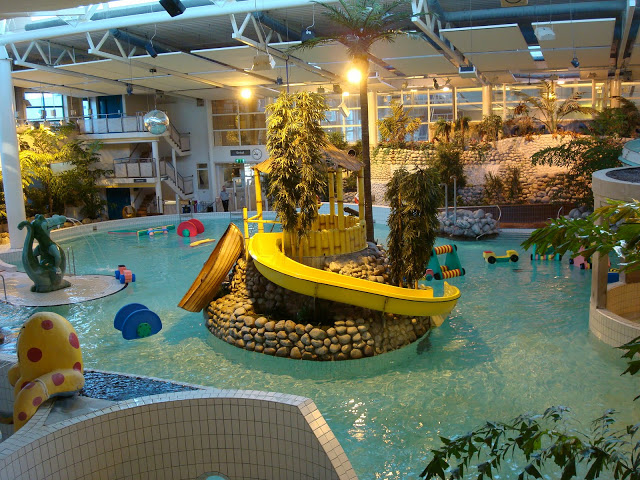
Fyrishof in Uppsala - now that's a swimming pool!
When the council closed Leith Waterworld, we were devastated.  My daughter, who had done baby swimming lessons there as well as regular family outings,  cried and cried.  We tried taking her to the Dalry Swim Centre for lessons but she hated it. When the Commonwealth Pool re-opened, we tried it with no more success It just wasn't 'fun'.  Her little brother has only once been to Waterworld, when he was a few months old just before they closed it.  But we do know how much fun a family can have at a waterpark. Pictures of our trip to Sweden - I was at a conference, it was the only self-catering accommodation we could find - hang on our kitchen walls. There are huge smiles on our faces.  Waterworld ought to draw people into Leith, and boost local businesses, as well as providing much needed family recreation for the local neighbourhood.

So when we heard in January that the Council would consider - support even - a community bid to reopen Waterworld, we were delighted.  It seemed like finally, things were being done differently. Which is why we all feel like we've been kicked in the guts today.  The council is going to vote tomorrow, but both parties in the ruling coalition support selling Waterworld for a derisory £1million so that a profitmaking firm can turn it into softplay.  There are already several softplays in Leith, and certainly no one is going to travel down Leith walk just to go to another one.  So this one will just take business away from the existing operations. I can't see any long-term financial logic, nor benefit to the council accepting the commercial offer.  The only justification seems to be that 'council officials recommended it'.

The council is trying to sell it as 'better than just another supermarket' and by assuring campaigners that the £125 000 which was to support their bid will still go towards 'free swimming' for primary kids.  But they don't understand that a play pool is different from lessons in cold pools with instructors yelling instructions from the side.

The comments on Andrew Burns blog are a must read. Passionate pleading for a pool that is warm, and shallow enough for toddlers.  The sloping 'beach' like entrance.  The waves and slide.  The Commonwealth pool does have a small pool for kids, but it's regularly too full and people are turned away. A pool where they can play with their kids, not watch them from the side. They put it so much better than I can.  Do read them.  

It's ridiculous that people are driving their kids to Dunbar and Perth so that they can play in fun pools, but it's even more devastating to have the council pull the rug out from under the feet of people who have been working hard to set up the bid.  

This decision has absolutely shattered the trust and faith of community activists, many of them just local families trying to work with the council to improve their local area.  For many this will have been their first taste of activism and engagement. What message have they been sent?  That the council doesn't care about them. That their elected representatives can't be trusted. That's going to be the long term legacy of this decision. And that's even sadder than all the kids who will not know the fun of playing in warm water with their parents and learn to love water and sport.

23 May 2013

Why I can't see past the obstacles to being strategic


A local politician keeps telling me to 'think strategic' and 'not bother him (and others) with the little stuff'.  He means well, but day after day I see little stuff that drives me crazy.   

I can't help but think that if we didn't have to spend so much time on the little stuff, maybe we could actually find time to think strategically? But that means getting stuff right the first time, and joining up the various policies. 

A few weeks ago, the administrator of CCE and I had a meeting with a council official about some inadequate bike infrastructure near my kids school (more about that later).  He also pointed out that the sightlines on one of the crossings in front of the school are obstructed by recycling bins - as you can see in the picture.  

We were assured it would be looked at and dealt with. But a few weeks later, it looked like this:

And then like this:

And then today like this: 

Each time I've noticed this and taken pictures, I've tweeted the relevant authorities and been assured it is being dealt with.  

Reporting faults by twitter is pretty easy, and not that time-consuming.  But as long as very simple policies like 'not obstructing pedestrians sightlines' at crossings can't be managed, how exactly are we supposed to think strategically and focus on the big picture? 

I'm not posting this to beat up on the folks who have been responding to my tweets, but to make the point that the best policies -- whether tenement recycling schemes or safer travel for schoolkids -- are only as good as their implementation and maintenance.   

21 May 2013

What's so different about cycling?

My kids seem to do pretty much everything in school - someone teaches them swimming, dancing, tennis, plus normal PE.

But, when it comes to learning how to ride a bike, although there is a prescribed curriculum, and a commitment from the council to ensuring that it is delivered to all P6s, it all depends on parent volunteers.

Why?

Cycling isn't just a sport. It's also life-skill.  It will help them get to their sports practices, their summer jobs, and to lectures at uni.  It helps us remain healthier as individuals and as a population.  It keeps our environment in better shape, and reduces congestion on the roads.

But it's not important enough for schools to actually pay trained professionals to deliver this training to our kids. I'm sure the volunteers are great, but it also means very uneven implementation - and that's before we even get to the schools that ban kids from riding their bikes to school so that they can learn how to ride their bikes....

So why is cycling the one sport/activity (as far as I can tell) that schools are expected to deliver in class time, but through volunteers?


We're not #bloodycyclists, We're everyone

If one message came out of this year's Pedal on Parliament, it's that we're not 'cyclists', we're everyone.   The wonderful Sally Hinchcliffe put this down in words and it was picked up by the Herald, and Scotsman.
This is the start of our 140+ feeder ride to the main Pedal on Parliament

We often say that cycling infrastructure needs to be for everyone from 8-80 and on Sunday friends of mine from many different walks of life - work, sunday school, pub mates - were there ranging in age from babes in arms to octogenarians (My friend Bill is desperate to know if he was the oldest again :)

Right now, on twitter there's a campaign to reclaim the hashtag #bloodycyclists.  As @citycyclists said "Let's get 'I'm one of the " trending? I bike. I don't want to be bloody because some idiot doesn't like my transport choice" This is in response to the dangerous and very foolish young driver in Norfolk, who knocked a cyclist into a hedge, lost her side mirror, and kept going only to tweet about it.

Yes. the double meaning makes it extra powerful. And some of the testimonies are very powerful. Like others, I too have been a #bloodycyclist. And I'm terrified my kids will be too.

But I'm not just a #bloody cyclist. I'm also a mum, a teacher, a member of our parish church, and most importantly a voter.

We're not #bloodycyclists. We're everyone.

16 May 2013

Why we need to Pedal on Parliament

Map showing detail for this section of the journeyThere's a lot of craziness involved in planning pedal on parliament, but right now, my biggest headache is how to get a group of families safely along the 1.75 miles between Harrison Park and the Meadows. 

All of the route - except the little section that you can see here -is off-road.  But that little section between two wonderful family-friendly routes includes one of Edinburgh's least cycle friendly intersections.

Last year we had some nice policemen come along and stop traffic for us.  Which was great, except that apparently this year, they won't do that.  So, we're stressing and kind of hoping we won't have 120 cyclists like we did last year. Cause it will take us ages to cross at that rate, even if we all dash across on the green man. But the bigger issue is that most days, we all have to negotiate dodgy intersections like this one.

This illustrates why Pedal on Parliament is so essential - it is ridiculous that families with kids don't feel safe cycling between the canal and the meadows.  How can we expect them to go anywhere in the city if they can't do that?  The good news is that the City of Edinburgh recognizes this problem, and it is near the top of planned infrastructural improvements as part of their Active Travel Action Plan.

But this is only going to actually be implemented because the Council is committing 6% of its transport budget to Active Travel, with a planned increase of 1% each year until they reach 10%.

Edinburgh is one of the only municipalities to spend this high a proportion of its budget on cycling.  But the effects are clear - in increased numbers of cyclists every year. This shows what can happen if the Scottish Government also commits itself to a target of 5% of the budget for cycling and 10% for Active travel, as we call for in our manifesto.

But we need to get to the Meadows first in order to ask them to do so - any volunteers to ride with us?   https://www.facebook.com/events/150599691787564/


10 May 2013

The H-word

How many of us wear helmets so that when we get squashed the judge can't say it was our fault?   I know I'm not alone in doing this.

But as I wrote a letter to the procurator fiscal (you can too) about the leniency shown in the sentencing for Gary McCourt for the death of Audrey Fyfe, I found myself even less able than normal to justify this position.  And for several days this week I have left my helmet at home.

I don't need (nor want) to read any more studies or studies about the health benefits/disbenefits of helmets.  I've not changed my mind on that.  But I am angry that the judge had the temerity to claim that her not wearing a helmet contributed to her death, when there is absolutely no evidence to back that up. The only person responsible for Audrey Fyfe's death is the man who was in charge of the powerful machine that hit her bicycle. And we need a legal system that acknowledges this, and holds careless and dangerous drivers responsible for their actions.

So, for the moment, I am helmet-less.  I will probably revert -- especially in the dark winter when even my short commute feels perilous -- but right now, this is my small gesture in support of Audrey Fyfe. I only hope I'm still cycling when I'm 75.

14 April 2013

Good for business?

There's a lot of data around these days pointing out that cycling is good for business and that cycle-lanes drive up footfall etc

But I've been struck by how many new cycle-related businesses have started up in the past two years or so

My attempt to itemize them (much helped by this useful site) came up with:

3 new tour companies: Storybikes, Tartan bike tours and Edinburgh Bike Rides

Loads of new repair shops:  The Bike Garage,  the Bike Smith  Harts  Pedals &  Greasemonkey,

Bike sales:  A couple of  big national players -- Evans and Decathlon -- have opened up and   although the Bike Chain has sadly closed, the Bike co-op is keeping the shop open as a second Edinburgh branch.  There seem to be fewer new, independent retailers, but considering that we have a total of 14 already, perhaps that's not so surprising. One exception might be the redoubtable Laidback bikes, which  has now got a 'proper' shopfront in Marchmont. There is also a new second-hand dealer: Soulcycles.  Their website's a bit primitive, but like a lot of the newer shops, they're using facebook quite effectively to promote themselves.

Even one cafe: Ronde and two pubs:  Ventoux and Tourmalet....

Couldn't some enterprising researcher or journalist work out their contribution to the local economy, jobs, etc and quantify it for us?

Parent solidarity needed?

On Friday, I wrote two posts about cars/driving/traffic near my daughter's primary school.  Well worn territory for me, unfortunately (see 'school run' labels). That same day, the Guardian ran a piece about getting kids to school on bikes.

Nursery run!
All this fed into a couple of discussions on CityCyclingEdinburgh - one about a school which had 'banned' kids from riding to school  and another one where a lot of money has gone into building a turning circle in front of the school, apparently to facilitate car-based drop-offs.  But we also know of schools in the vicinity with really enthusiastic programmes supporting cycling and walking to school.    And in other places, the police and traffic wardens are supporting various initiatives - like adding double yellows to zigzags and banning cars from 300m from school entrances. 

This unevenness leads to the ridiculousness of kids being told in writing that they have to push their bikes to school, while just down the road, the Head Teacher at my school - despite being personally supportive - says that she can't do anything 'beyond her gate' i.e. all the parents who stop on the zig-zags and 'keep clears' and double-park in the road to drop off their kids.

But it's not just that these policies are random and  incoherent, and that enforcement varies greatly, but also that groups of parents feel isolated and  uncertain of what their rights are, or what other schools are doing to change things.

There seems to be some momentum for a city-wide meeting of parents to discuss how different schools deal with such issues and what lessons can be garnered.  I'd also like to have some representation from Council, either from the road safety or active travel teams, as they have a lot of knowledge and experience.

There's a couple of different issues bundled in here - encouraging more kids/parents to use active travel to get to school where appropriate but also making the streets around schools safer in general.  We all know how quieter and safer the streets feel when the schools are on holiday, but it shouldn't be like that. I'd like to see them safer when the kids are on them, not when they're at home or in the park playing!

If you'd be interested in getting involved, or just attending a meeting to share ideas, please get in touch via comments, twitter, or email.

12 April 2013

Why people stop cycling...


View Larger Map


This is a lovely intersection that I go through most mornings. There are at least 3 primary schools in the vicinity, and myriads of nurseries. It's also a main throughfare between two much used parts of the off-road network. So lots of bikes, and as you can see, a pretty decent layout for cyclists wanting to cross at the Toucan crossing.

But, earlier this year a neighbour of mine was knocked off here by a supermarket delivery van turning left. My friend was going straight on like the royal mail van.  (Oh, and he thought he was okay, but was later rushed into hospital for emergency surgery). Not nice.

And then this morning, as I coasted up the little ramp on the left, I saw a dad with a bright eyed toddler on the back nearly get left-hooked in exactly the same place by a blue Volkswagon that, just like the Tesco van, some how 'didn't see' the cyclist who had been coming straight down the hill for some distance.

This wasn't a cyclist who had just nipped into the car's near-side or anything else.  The dad had been cycling safely and carefully along. The kid had give me a big wide-eyed look as they went by, clearly enjoying the ride. And it came so close to tragedy.   Just because of inattention on the driver's part.

I really hope this dad doesn't stop cycling his wee boy to nursery, but I wouldn't blame him if he did.


Keep clear?

Yesterday and today I found myself stopping to take pictures of vehicles parked on the 'keep clear' area at the end of Montpelier, where there is a cycle-cut through to Viewforth (googlemap link here).  For those who don't know it, it is one of the main routes to Bruntsfield Primary school with hundreds of little kids coming through every morning, and also the route between the main Boroughmuir secondary school building and a smaller annexe.  So, well used by vulnerable road users.

Yesterday  there was a big scaffolding lorry completely blocking the space, stopped for an extended time, but with engine still running. Another mum on a bike came through just after me and commented that she was worried it was going to reverse into her.  But a look at the cab showed the drivers were stopped for a fag and tea break.  

Today it was 'merely' a white van, but knowing the difficulty that most of the cars that usually use that 'turning circle' have in making a 3 point turn, I'm inclined to think they're also causing an obstruction.

Ironically, both vehicles are most likely connected to the construction work on the school, so found a nice 'safe' spot to keep out of the way until the kids were safely inside.  But the keep clear being blocked means that all those parents who feel a compulsion to drive into the dead-end, so that they can drop their kids at the second gate then had to reverse back over the pedestrian crossing in front of the school.  And their doing that then lead to other parents reversing back over the other pedestrian crossing.  While hundreds of little kids were streaming across and into the school.

The thing is,  if the parents 'learned' that they couldn't expect to turn at the bottom of the road, maybe they would stop driving in there?  Because actually, they're much more of a menace to the kids and parents at the school than these vehicles are 'parked'.

And that's the real irony.  Police and traffic wardens would be happy to ticket these vehicles for being illegally stopped, but my efforts to get some back up which would discourage parents from driving in front of the school have simply led to platitudes in the school newsletter and some clever banners on the railings, with no discernible effect.


07 April 2013

Not much has changed...everything has changed.

Two and a half years ago, Edinburgh launched its Active Travel Action Plan.  In many ways, it's not a bad plan.  But it hasn't aged well, and the current review process is showing this up all too clearly.

First,  nothing much has changed. Of the things that I really wanted to see implemented via ATAP, very few have even begun.  Some of these are really small interventions like public bike counters (or just publishing the data that exists!), removing 'guard' railings, cycle contraflows on one-way streets, and tackling footway parking.  Others where we have seen incremental change include a piloted 20 mph zones (which leaves out all the big roads) and  better cycle parking (but not in the city centre!).

However, the star attraction of ATAP (or drawback for some), was the plan for a 'family network' (see map on page 23 of this pdf).  This approach comes in for a lot of criticism for directing cyclists along quiet roads, without doing anything much to improve the big roads that we all need to use to get to school, work and shopping.  I'm not convinced that this is an entirely fair criticism of Edinburgh's plan.  Our family network has the potential to be a lot more than that. Because we already have the extensive off-road network, the network was proposed to link up various bits of the city.  Right now, from where I live in south-west Edinburgh, near the canal, we can cycle to the beach at Cramond, or the Botanics, or Leith, or out to Musselburgh and go most of the way on lovely, well-maintained off-road paths.  But the remaining 10% of our journey is on scary, fast, poorly designed roads.

A few weeks ago, we had a lovely family cycle to Cramond. When we got there, we ran into a lot of people who live around us. They had all driven there so that their kids could cycle up and down the promenade.  Ironically, we'd probably gotten there faster - or certainly not much slower.  But they didn't feel that they could put their kids on the road even for that short section.

The Family Network is supposed to link all those bits up, so that you can go across town with your kids - faster than the buses - and not feel like a bad parent for risking their lives.  On page 22 of this pdf  you can read a list of the connecting bits that are prioritized for rapid completion. One of these has been done - an off-road connector between Leith and Portobello.  By all accounts it is a fantastic addition, and already encouraging new cyclists to start cycling regularly.

But none of the rest has been done.  And my concern is that plans for those mainly involve paint on roads, and that simply isn't going to get the South Edinburgh equivalent of the busy Mum who now cycles from Leith to work in Portobello on her bike, and certainly not if she has her kids in tow.

To look at just one example: the link from the Union Canal to the Russell Road access for the North Edinburgh Path Network. To anyone who knows this route, it is the most obvious, amazing access from South Edinburgh to the North (on the link above chose 'fastest route').  The Council's take on it is that there is an expensive off-road option that involves old railway infrastructure, OR a cheap on road access.  And, if you look carefully at the on-road access (very hard to see because the map is so tiny), it appears to take you on a twisty route through the car parks of various housing estates, Dundee Terrace, and then down the Telfer subway to the Dalry Road.  This is a massive diversion, and no real improvement if it just means paint on roads.  I dare you to find a parent who currently doesn't let their kids cycle on the road, who says this would make the slightest difference to them.

When I asked why not just make the direct route safer for cyclists, I was told 'we'd have to take road-space away from cars'.

There you have it folks.  Why Edinburgh's Family Network and Active Travel Action Plan - as presently being implemented - will never make more than incremental change to the number of cyclists on our streets.

We can have off-road cyclepaths -- where developments permit, or old infrastructure can be amended -- and on-road paint and signs, but we won't redesign roads so as to take roadspace away from cars.

This is where we come to what has changed since ATAP was launched.  Not in Edinburgh, but everywhere else.  In London, Chicago, New York, even Detroit, roadspace is being re-allocated away from cars to bikes, with spectacular results for local businesses and communities.  Edinburgh needs to realize that while their plans are still stuck in the past, the environment has moved on.


06 April 2013

A Cycling High Heid Yin?

I was sent this picture earlier today.  It's a salutary reminder of how far we have come.  On Monday, Spokes is holding a public meeting about 'the future of local transport', and an MSP and a local councillor are speaking.  The MSP is co-convenor of the newly created Cross-party group on cycling, while the Councillor is deputy transport convenor, with a specific responsibility for cycling.  It's a long way from local government with no real interest in or commitment to cycling, that led Spokes to cancel their 1980 meeting.

But despite all the remarkable changes -- most visible to many of us in the gritting of cycle paths this winter -- one conversation keeps recurring in different contexts.  And that's people saying - where's the blockage?   Is it the officials or the politicians?

Because somehow, despite the budget commitments, the explicit commitment by many Councillors, the good-natured cycling officers, the transport forum, a much lauded Active Travel Action Plan (ATAP), not much has really changed for cycling in Edinburgh in the 5 or so years that I've been back on the road (I was too scared to cycle here when we first moved here, despite having cycled in Canada, England and Zimbabwe).

The launch of the ATAP more or less coincided with my first foray  into cycle campaigning - at a Spokes meeting, where I suggested that maybe cyclelanes with parking bays painted on top of them shouldn't be counted in our grand total of 'x number of miles of cycle lanes'.  This seemed radical then, but I'm not sure it was, nor that it should have been.  When I pursued the issue, the then transport convenor told me that it was no longer council policy to put cycle lanes in where they could be parked on.

But where have we gone since?  There are no on-road segregated paths.. There are no mandatory cycle-lanes (ie ones that cars must stay out of).  Instead, we get the 'quality' bike corridor, where the painted lanes sometimes go around parking bays instead of straight through them.

I think this captures the issue that people are trying to get at, when they say 'where's the blockage? what is holding us back'?  There are valid points made about budgets, about a shortage of manpower, and many other issues that explain the failure to implement more than a tiny fraction of ATAP so far.

But the bigger question is, why has our vision stayed so stagnant?  Why are hesitant commitments to 'consider' cycle infrastructure only accomplished after great lobbying efforts?  Why is cycling infrastructure still not integrated into all planning?  It remains an after thought, a box-ticking exercise - despite all the good will at Council.

All this leads me to think that we need a cycling champion to overcome these roadblocks.  To knock heads together. To change how we think about cycling and to connect up all the synergies.  I'm not usually enamoured with this very English approach to policy-making, but if the alternative is wasting the enthusiasm and goodwill that is currently present, then I think we should consider it.  I suppose we'd need to call it something more Scottish though - how about a Cycling High Heid Yin?

In the meantime, I'm very much looking forward to this week's Spokes meeting.

17 March 2013

A letter to my councillors

My planned blog about cycle advocacy strategies has been hijacked by computer malfunction and the need to write to my councillors.  So I'm taking a leaf out of Dave McCraw's book, and posting my letter here (but do read Dave's too): 


I understand that the Council is taking several important decisions in the next few days and weeks that will very much affect transport and cycling in Edinburgh. As you know, I think the council's made some amazing strides forward in recent years and that we are moving in the right direction.  Indeed, I had a message on facebook only this morning from an old friend in Canada, who was absolutely flabbergasted when he heard that Edinburgh was committing 6% of its transport budget to cycling.  He's trying to convince his city to commit 1% and not getting
very far. So, I know you're doing something right!

Nonetheless, I do wish to emphasize how important it is that any  major shifts in Edinburgh get things right this time, and not require further tinkering and costly remedial adjustments.  In particular, this relates to both Princes Street and Leith walk.  We have a real opportunity here, and it matters that we get it right, if we are to enable cycling  in Edinburgh, with all the concomitant benefits - including for businesses.

I understand that the current plan for the redesign of Princes St and George St basically treats cyclists like cars, but provides some extra segregation on George Street. While the segregated path is obviously beneficial, banning cycles from Princes Street eastwards is really retrograde.  This is not how Copenhagen or any other city has supported and encouraged cycling.  Instead, what we see is the widespread and extensive provision of cycling contraflows, of two way segregated paths, and/or cycling encouraged in pedestrianized areas.  Cyclists are not drivers - they are mobile shoppers who will stop at markets, browse stalls, and pop into cafes.  We want to encourage this, not erect 'no cycling' signs right outside Waverley as a greeting to arriving tourists!

It is thus vitally important that the 'steer' the Transport Cttee gives to the proposed plan is one which emphasizes the importance of making cyclists and pedestrians welcome in the city centre. I used to cycle
down to Princes street a lot for shopping and I look forward to being able to do so again.  But I am convinced that the future of the city centre depends on making this easy, safe, and fun to do, not by restricting access unnecessarily.

I understand that the Transport Cttee is also considering the proposals for Leith Walk.  I have contacted you on this before, and have made my input through the consultation process.  I would simply add at this point, that if we are really serious about making Edinburgh a cycling city, Leith Walk is an opportunity that we cannot afford to miss. It is one of the scariest roads in the city to cycle on, and not very pleasant to walk either (as I did for 5 years), but it has such potential, both in terms of its width and the wonderful shops and neighborhoods.  Again, let's remember all the research indicating how shops and restaurants elsewhere have benefitted financially once
segregated cycle paths were installed.  And remember also that as in London, a remarkably high proportion of residents in and around Leith Walk, are not car owners.  Whether they choose to walk, cycle or bus, these residents will benefit from cyclepaths beside the footpaths.

I'm sure you've  read the London vision for cycling - and compared it to ATAP.  Edinburgh gets mentioned rightly for its financial commitment to cycing, but let's make sure that we spend that money wisely on good quality infrastructure (which is not necessarily expensive infrastructure), rather than risk another farce like the QBC.  While retrofitting infrastructure can be expensive, the Leith Walk proposals are an amazing opportunity to move forward and integrate cycling into our travel plans, in a way that we have rarely been able to do.

Apologies for this long message.  Please don't feel you need to reply, but I do hope you will bear these points in mind when you and your respective parties make decisions, and especially in consultation with your colleagues who sit on the Transport Committee.

All best wishes,

09 March 2013

What's so bad about the QBC?

London's announcement seems to have rekindled the debate (on forums, blogs, twitter and even in the comments on my last blog post) about the so-called Quality Bike Corridor (QBC) which runs through south Edinburgh. It's been touted as a great improvement, and much money was spent on it. But since it opened the outcry has been loud and sustained. Even the council leader has weighed in, rather critically in fact.

It has also amplified divisions - or at least articulated them - between Spokes, the doughty cycle campaigners, and a variety of other voices. After reading some of the exchanges, you'd be forgiven for thinking that we were all at each other's throats. That's not really the case - we all respect Spokes' dogged persistence and reliable data.  Many things have happened for the better in Edinburgh because of Spoke's interventions, despite being run on a shoestring of a budget, and entirely based on volunteers.

The basic position though, is that while pretty much everyone agrees that the QBC is simply not good enough to get kids etc cycling safely, Spokes argues that their data suggests it may have nonetheless increased cycling levels, and hence is still a good thing, if less good than it could be.  Others suggest that it is a total waste of money.

I'm not totally convinced that the QBC explains the cycling data, but it may be that Spokes is right that the QBC by virtue of its presence, and the publicity given to it, has enabled some cyclists.

The problem though is that the QBC ought to be the most basic level of cycle infrastructure - the lowest common denominator - while it is being touted as an improvement.  In fact, given that part of the QBC doesn't even have an on-road lane painted on it, it might not merit even that. But, it doesn't have parking bays painted on top of the lane. There are some restrictions on stopping and loading.  Both of those make it better than many other cycle lanes in Edinburgh. But that's not saying much.

Several years ago, at my first foray into bike campaigning, I challenged the then transport convener about the bike lanes that had parking bays on them.  He admitted that they were less than optimal and said that Council policy had changed and that they would no longer build cycle lanes with metered bays on top. The QBC is clearly the outcome of that policy.

Rather than saying - 'Look at the QBC, it's so great!'  maybe we should be saying 'the QBC's a bit better than the lanes elsewhere in the city, but it's not good enough'.

As others have said, it may provide some sort of support for determined/experienced cyclists, but it is not the sort of infrastructure that will get more 'timid' cyclists out, and keep them on their bikes - and that's what we need, and what the Council needs to invest in.  Let's not aim for the LCD any more.

What's the difference between London & Edinburgh?

Reading Boris' vision for cycling in London was a revelation.  Not because I believe it will all happen, or that funding's in place for it all, but because the tone was so different from what we have heard and seen elsewhere.  Edinburgh's put its money where its mouth is and committed 6% of the transport budget - capital and recurrent - to cycling.  And we've already seen the effect of this - particularly in the gritted cycle paths that made such a difference this year.

But Boris' vision simply felt different.  My husband described it as a 'wishlist' for cyclists. But it wasn't just that they bodged in all sorts of good stuff.  Rather, it felt joined-up as a policy.  Not just a tick-list but thinking about what was needed.  I have blogged before about the need to integrate cyclists into urban planning - this plan feels like it really does that, with a commitment to a properly funded junction review, redesign of town centres, and  revising design standards.  While the Scottish CAPS foregrounds 'training', the London vision sees it as merely an add-on to other important aspects of the scheme. We've asked for infrastructure to be joined up, but here not only is infrastructure joined up, but so is the policy.

Despite all that good stuff, the real difference in the London plan to Edinburgh's ATAP was one of tone, and that tone is at least in part a reflection of one important difference.  In London, it is accepted that the most efficient way to get somewhere is not necessarily a private motor vehicle.  And car-parking does not seem to be taken as the same sort of 'right' by residents - or at least that's how the local press portrays it.  I've seen so many more cyclists around - especially lots with child seats, that I think this is changing, but it's not reflected in our public discourse, or in our policy formulation.

London planners and politicians are starting from a different place, emotionally and strategically.  The census data in London showed very clearly that car ownership and use has fallen dramatically in recent years across all demographics and political orientations. Add to that, London's over-used and overcrowded public transport system - again used by every variety of commuter.  Boris' vision is compelling because he sells it as something that is good for everyone - this is a win-win policy.

A lot has been made of the role of cycle bloggers in pushing policy change.  But the other big difference between Edinburgh and London is that in London, the local media is on-board.  In Edinburgh, the politicians continue to run scared of the local media, which - with very few exceptions - is heavily pro-car and loves to bash the council.

I don't think these differences are unsurmountable, but the Council and its officials need to get their heads around the idea that Active Travel can be a 'vote-winner' (as I heard the Deputy Transport Convenor say recently), and, as residents, readers and consumers, we need to make sure that the incremental changes in how we travel are reflected in policy-making and public debates.


01 March 2013

What does it take to make cyclists happy?

What does it take to make cyclists happy?

Dropped kerbs.
Photo courtesy of chdot via flickr

Honestly.

You think that sounds silly?  On the one hand, I agree with you. With fatalities from crashes and obesity epidemics, you'd be right to think that we need to think big about safety and supporting novice cyclists.  And that's going on too (keep Sunday 19th of May clear in your diaries).

But sometimes the smallest victories are the sweetest. And this week, a dropped kerb that I've written many emails and tweets about was finally installed.

It may not look like much, but it is one of the main access points to Harrison Park and the Union canal towpath.  This means that hundreds of commuters and leisure cyclists use it everyday.  And, anyone who's tried to get a bike with a childseat, tagalong, or trailer up (or down) a dropped kerb, knows just how much harder that is.

The depressing thing is that this bit of kerb had actually been dug up and replaced a year or so ago, well after this kerb was supposed to be on a list of planned improvements in the area.  Like the pothole patching I blogged about earlier in the year, it is just such a waste.


More pics in my flickr stream 
And its not like this is the only one. At the top of Middle Meadow Walk -- probably the most used cyclepath in Edinburgh -- a dropped kerb disappeared when roadworks were done.  It was reinstated earlier in the year, which made us very happy, except that the path markings continued to push pedestrians and cyclists into confrontation.  But finally, amid much celebration, the signage has been much improved.

So we're talking not just about small things making us happy, but retro-active things, which ought to have been unnecessary.

Is this wrong? Ought we to be more focussed on the big picture? Getting policies in place? Yes.  that's important too.  But there's a case to be made for incremental change too. And a quiet satisfaction in getting it done right.

Now, we just need to get that cycle counter installed on Middle Meadow Walk....


28 February 2013

I can't win


Our first trip with the trailer. Picking strawberries to jam.
Most of the time, I'm fending off comments about how 'brave' I am to cycle with my kids.

To begin with, this meant taking my daughter to nursery in a bike seat. Then when she outgrew that, we got a tandem.  And, about that time, she started riding her own bike. Like most parents we assumed she would ride on the pavement (sidewalk to the North American readers).  But that made going places tricky and slow. Since most of our roads are lined with parked cars, this means that often we couldn't see her, and were riding too slow for the traffic flow.  Then, at age 4, she had a fall over the edge of a kerb and onto the road. And declared she wasn't going to ride on the pavement anymore.  We humoured her for a bit, thinking she'd probably go back to riding on the pavement. And gradually we developed the necessary skills to ride with her on the road.  She's never looked back. And at age 6, she's got a pretty good sense of how roads work, and how to cycle them.

But, the 'brave' comments keep coming.  Mostly it's code for 'crazy'.  Or 'bad parent'.  I'm sure the parents trying to drive their kids to school in 4x4s say even worse things.

The thing is, among cycle campaigners, I get flack from the other side. Snide comments about helmets and hiviz.  About how cycling ought to be for 'normal' people.  Not all of this is nasty.  Much of it is well-intentioned like the great people at Spokes, who want to see more pictures of cyclists in 'normal' clothes.

But they're still telling me that I'm doing it wrong.

I can't win.  So, you know what? I'm just gonna ride my bike!  (and keep on campaigning to get more people out there, and to make the roads safer for all of us)

Twitter as an academic search tool = user beware


I'm delighted that journals are using social media to promote journal articles.  It's a brilliant idea.  @T&F_Africa is really pioneering this, at least in my field,   tweeting links to pertinent, if not necessarily recent, articles.  I quite often retweet these to my students.  But the last two times I have followed their links, I've had second thoughts about those retweets.


The first time, it was a link to an article about Islam and the WoT in Mali. Fascinating stuff, and from 2007, so a good background to the current crisis.  But the more I read the paper, the more concerned I became. It's a thoughtful piece, which draws some reasonable conclusions.  But nowhere are we told anything about the author or his research.  We don't know if he's ever visited Mali, if he speaks the languages, if he did research there via a research grant, or while in the US military. The paper is reasonably referenced - albeit entirely to secondary sources -  but I can't judge its value, or robustness, without knowing something about how the analysis was generated.

Today @T&F_Africa  tweeted a link to a paper on 'ethnic terrorism' in Kenya.  Interesting, I thought, if a bit tendentious.  But again, while this paper does give us the author's affiliation, we have no way of judging how much of an 'expert' he is.  Did he spend several months in the field?  or is it 'armchair' research from the comforts of home?  Again, the footnotes seem to be in order, but with no discussion of methodology, I'm left wondering why this author is positioning himself as an 'expert' in this sensitive field.

I don't really blame the authors for these oversights, but what were the editors doing letting articles get published without such basic information?  Do they think about how to strengthen articles? how to make them more robust and effective?

There's a comment somewhere in my twitterstream from an academic saying 'I only ever get boilerplate letters from editors'.  It worries me that this may be becoming standard.  Surely editors have a duty of care to their authors to help them improve articles?

Or am I being too precious, and as long as the footnotes are there, anything goes?